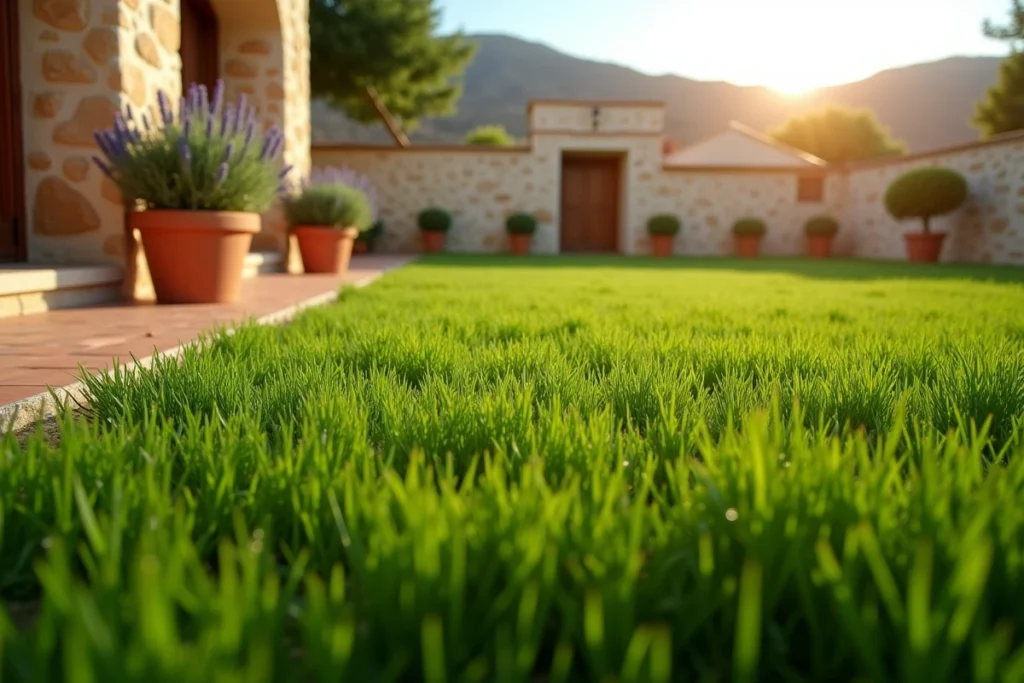
On a south-facing plot between Montpellier and Toulon, a lawn seeded with classic English ryegrass turns yellow by mid-June and sometimes only recovers in November. The problem does not stem from a lack of watering, but from an unsuitable seed choice from the start.
In a Mediterranean climate, the grass must withstand very high ground temperatures, increasingly strict water restrictions, and often calcareous or stony soil. We are not looking for English golf course grass; we are looking for ground cover that can survive without constant irrigation.
Watering restrictions and new rules: the framework has changed
Since 2024, several local authorities around the Mediterranean have tightened their watering regulations for private green spaces. Guidelines introduced in 2025, notably documented by BRL (the irrigation manager in southern France), modify the regulatory framework for water management to account for the recurrence of droughts and heatwaves.
In practice, this means that creating a large traditional lawn is no longer legally viable in many municipalities. The permitted watering volumes are capped, and drought decrees escalate to heightened alerts faster than five years ago. One can no longer compensate for a poor choice of grasses with generous watering.
This context requires choosing grass suitable for the Mediterranean climate right from the seeding phase, targeting species capable of surviving prolonged periods without irrigation, not just tolerating a few days of heat.
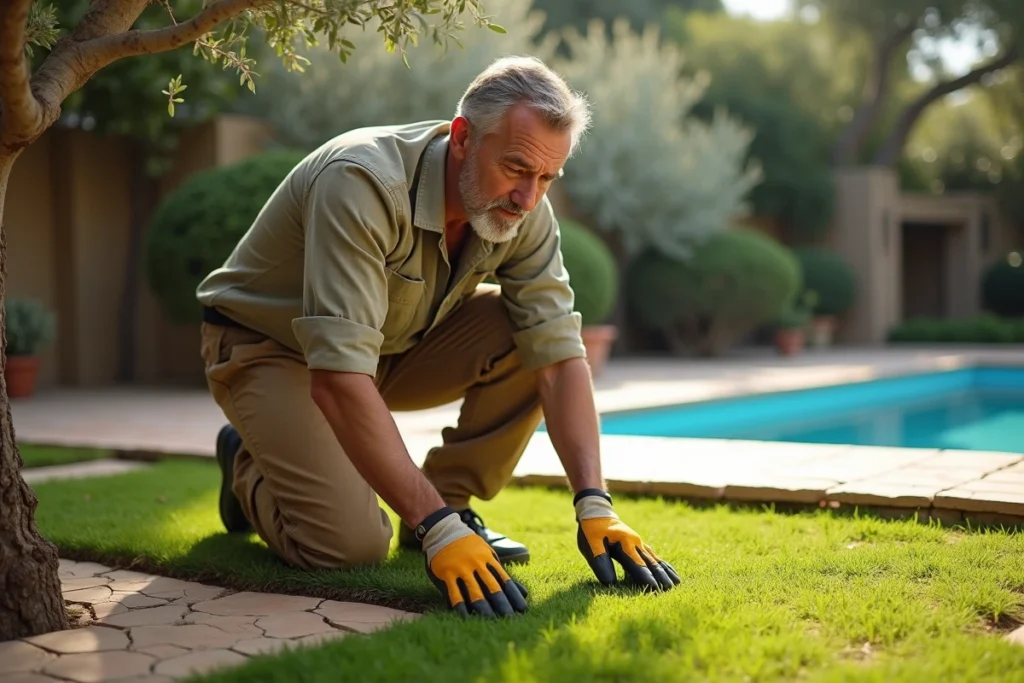
Tall fescue and Cynodon dactylon: the grasses that truly endure
Not all mixes sold as “drought-resistant” are equal. There are bags on the market containing a majority of English ryegrass with a sprinkle of fescue to justify the label. This is not enough.
Tall fescue, the backbone of Mediterranean grass
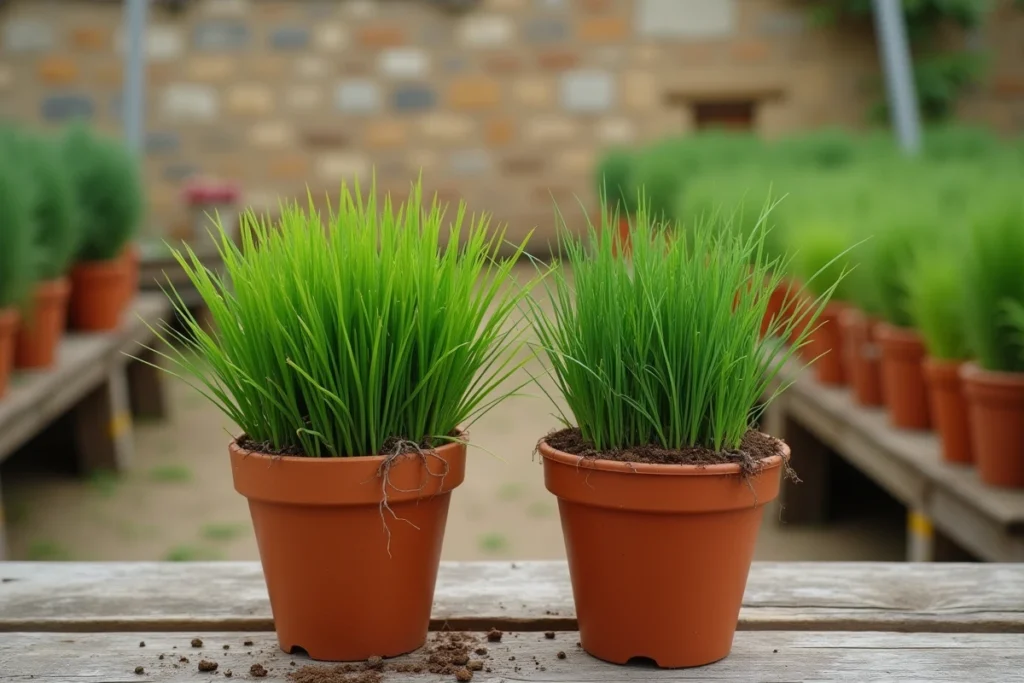
Tall fescue develops a deep root system that allows it to capture moisture well below the surface. It tolerates heat, calcareous soils, and spaced watering. It is the base grass for any serious mix in a Mediterranean climate.
Red fescue complements the mix well by providing a finer texture and good coverage in partial shade (at the foot of a wall, under an olive tree). Feedback on this point varies depending on exposure and soil type, but the combination of tall fescue and red fescue generally yields a dense and uniform result.
Cynodon dactylon for extreme situations
Cynodon dactylon (Bermudagrass) is a warm-season grass, meaning it actively grows in summer when others turn yellow. It withstands very high temperatures and prolonged aridity.
Its drawback: it turns yellow in winter and takes on a straw-like appearance from December to March. For those who accept this aesthetic compromise, it is the most drought-resistant grass available in seed form. It can also be combined with fescues to limit winter yellowing, but cohabitation requires differentiated mowing management.
Calcareous soil and land preparation: what happens before seeding
In the Mediterranean zone, the soil is often calcareous, compact, and shallow. Seeding directly on a superficially worked soil condemns the lawn to struggle from the first summer.
- Loosen the soil to at least twenty centimeters before seeding, ideally with a grelinette or tiller, to allow roots to penetrate
- Add organic amendment (mature compost) to improve water retention in very draining or stony soils
- Check the pH: a very calcareous soil (above 8) limits nutrient absorption by grasses; an application of elemental sulfur can help correct this gradually
- Plan for a light mulch on the surface after seeding to maintain moisture and protect young shoots from direct sunlight
This preparation takes time, but a well-prepared soil reduces watering needs by half in the first year.
Fall seeding and mowing height: two often overlooked levers
Why seed in the fall in a Mediterranean climate
The spring reflex does not work well here. A seeding in March or April leaves barely two months for young shoots before the first heat. By seeding between mid-September and the end of October, one benefits from still warm soils, regular autumn rains, and several months of rooting before the following summer.
Seeds germinate quickly when the soil is between 15 and 20 degrees. The Mediterranean autumn offers exactly this window, with the added benefit of much lower evaporation than in spring.
Mow high to keep grass green longer
There are still many lawns mowed very short in the south. This is counterproductive. Maintaining a mowing height between 6 and 8 centimeters protects the soil from evaporation, encourages deep rooting, and limits thermal stress on grasses.
A lawn mowed to 3 centimeters in mid-July burns within days without watering. The same lawn at 7 centimeters retains a green hue much longer. This simple mower adjustment makes more difference than any summer fertilizer.
Natural or synthetic grass: a decision that depends on the area
Synthetic grass appeals due to its total lack of maintenance and watering. For a small area (around a pool, terrace), it is a defendable option, especially in areas where water restrictions are very strict.
On a significant garden area, artificial grass poses a real heat problem. Measurements reported by several specialized sources show that synthetic grass can reach surface temperatures around 60 degrees in summer, making the surface impractical for bare feet and contributing to the heat island effect. Natural grass, even when yellowed, remains significantly cooler to the touch and helps cool the surrounding air.
- Small area without regular foot traffic: synthetic grass may be suitable if one accepts the surface heat
- Family garden with children or pets: natural grass remains preferable, provided the right grasses are chosen
- Mandatory clearing zone (OLD): check local regulations, as some municipalities impose constraints on flammable materials in sensitive areas
The right Mediterranean grass is not the one that stays green twelve months a year. It is the one that greens up quickly after autumn rains, holds up without excessive watering in summer, and does not turn the garden into a heat plate. Tall fescues as a base, Cynodon for the most exposed areas, fall seeding, and high mowing: these four technical choices make the difference between a lawn that survives and a lawn that thrives.