
A charm planted at the property line grows 40 cm per year, and after two seasons without intervention, the hedge overflows onto the sidewalk. Trimming hedges is not just an aesthetic gesture: it is a technical, regulatory, and seasonal constraint that affects the health of the shrubs as much as the tranquility of the neighborhood.
Nesting and the Environmental Code: what really exposes you to sanctions
It is often said that it is “forbidden to trim hedges from March 15 to July 31.” The legal reality is more nuanced. There is no single national law in France prohibiting individuals from trimming hedges on specific dates.
The sanction comes from the Environmental Code, which protects the nests and habitats of protected species year-round, not just in spring. Destroying a bird’s nest while trimming a laurel hedge in April or October exposes one to the same penalties: up to 3 years in prison and a fine of 150,000 euros.
For farmers receiving CAP aid, the situation is different. Conditionality imposes a ban on maintaining hedges and thickets from March 16 to August 15. Several prefectures (Oise, Bas-Rhin, Haut-Rhin) have issued similar decrees in rural areas since 2023-2024, prohibiting work on hedges from March 15 to July 31 inclusive.
In practice, reference organizations such as OFB and LPO recommend avoiding any trimming between March 15 and July 31, even in a private garden. Before taking out the hedge trimmer, one should visually inspect each section of the hedge to spot an active nest. A methodical eye-level inspection, branch by branch, takes a few minutes and avoids a considerable fine.
Trimming hedges at the right time: the calendar that preserves your shrubs
The trimming calendar directly depends on the species planted. There are two main categories, and confusing them can permanently damage the hedge.
Spring-flowering shrubs (forsythia, deutzia, mock orange) bloom on last year’s wood. Trimming them before flowering removes the buds. These species are trimmed just after flowering, generally between late May and early July, respecting the nesting window.
Summer or late-flowering shrubs (buddleia, hibiscus) bloom on this year’s shoots. They are trimmed in late winter, between February and early March, before the vegetative restart. This is also the safest window regarding wildlife.
For evergreen hedges like thuja, laurel, or privet, maintenance trimming ideally occurs twice a year: a first pass in February-March before growth resumes, and a second in September, after the sensitive nesting period. Opinions vary on the necessity of a third summer pass, but it remains discouraged as long as birds are nesting.
Resources like sculpte-haie.com detail techniques suited to each type of hedge and help choose the right equipment based on branch thickness.
Topiary hedge trimming: geometric shapes and maintenance constraints
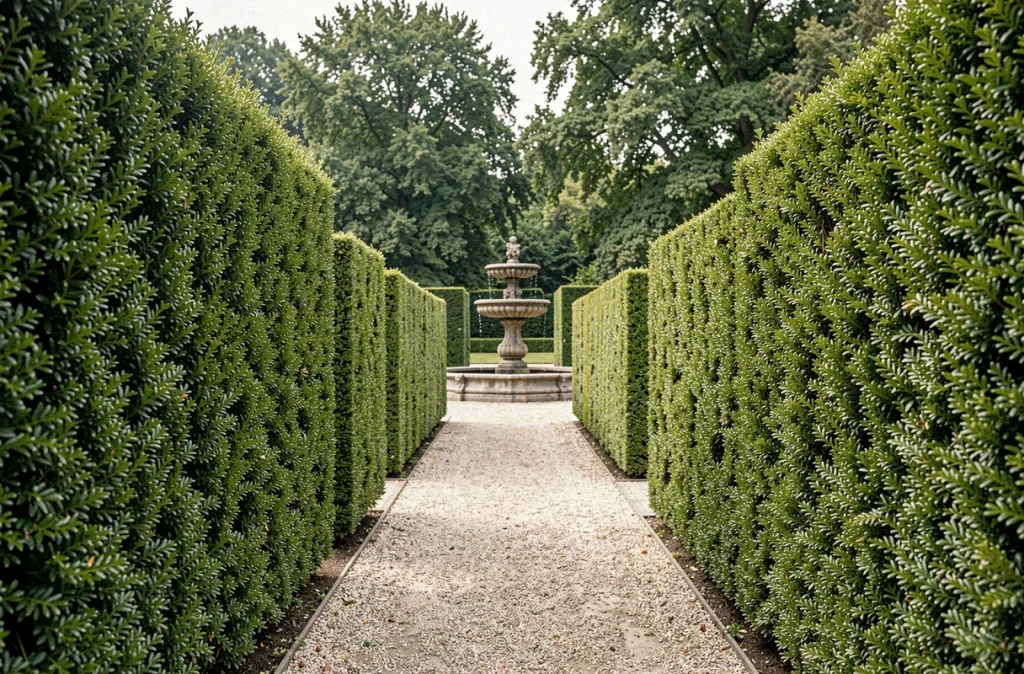
Topiary trimming transforms a simple alignment of shrubs into a sculptural volume. You see spheres, cones, crenellations, and sometimes animal shapes in the most elaborate gardens. The principle remains the same: little material is removed with each pass, but one trims often.
Species that tolerate topiary well are those with dense foliage and slow or moderate growth:
- Buxus remains the reference for small shapes, despite the box tree moth that requires close monitoring of the hedge between May and October.
- Yew (taxus) tolerates severe trimming and can regrow on old wood, allowing for corrections of a failed shape.
- Hornbeam and beech offer marcescent foliage that retains a curtain of dry leaves in winter, useful for privacy.
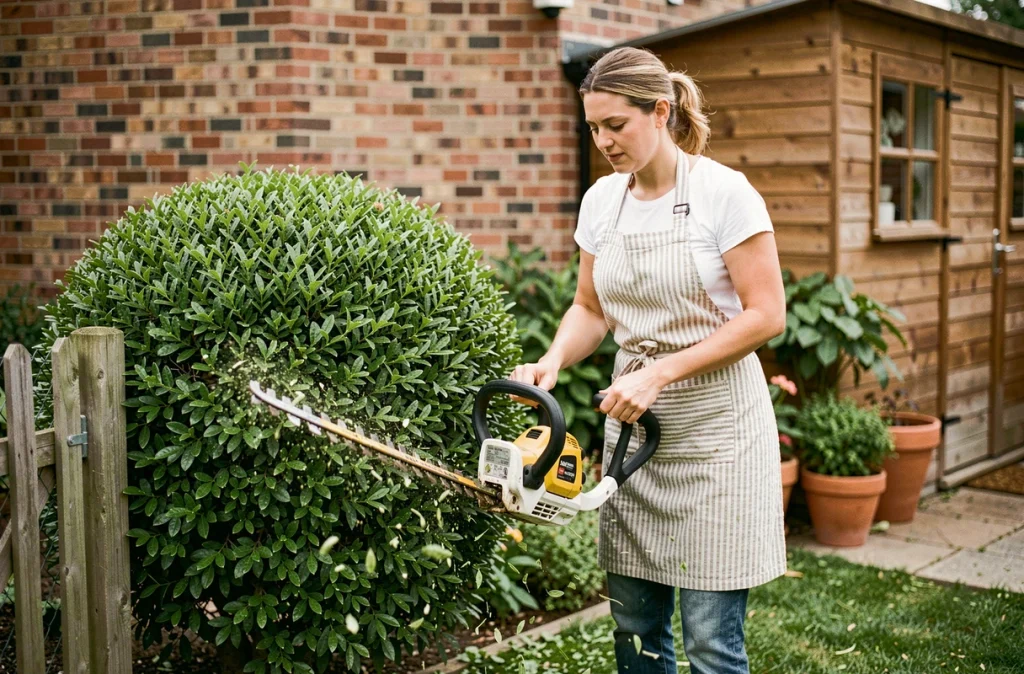
A topiary shape requires at least three trimming passes per year to remain neat: late February, late June (avoiding nests), and September. Each pass removes a few centimeters of growth. Hand shears are used for small subjects, while electric hedge trimmers are used for larger volumes.
A common mistake is to trim the hedge narrower at the bottom than at the top. The base must always be wider than the top to allow light to reach the lower branches. Without this trapezoidal shape, the bottom becomes bare in two or three years, and the hedge loses its opacity.
Free hedge or trimmed hedge: choose according to available space
The trend towards so-called “free” or wild hedges is rising in urban gardens. A mix of deciduous and evergreen species, berry and flowering shrubs, creates a vegetative screen that varies with the seasons and nourishes small wildlife.
This type of hedge requires less trimming but more space. A free hedge easily occupies 1.5 to 2 meters in depth, compared to 40 to 60 cm for a strictly trimmed hedge. In a narrow city garden, the free hedge encroaches on usable space and ends up being drastically cut back, which disfigures it.
For a plot of less than 300 m2, a monospecific trimmed hedge (hornbeam, photinia, privet) often remains the most coherent choice. You gain density, regularity, and ease of maintenance.
On a larger plot, a mixed hedge composed of five to seven different species offers real ecological interest. It incorporates shrubs with staggered flowering to spread resources in pollen and nectar over several months.
- Red dogwood and viburnum for structure and autumn berries.
- Hazel and elder for height and quick fruit production.
- European spindle and common privet for dense foliage at the bottom.
The choice between a free hedge and a sculpted hedge depends on the relationship between the garden’s surface area and the desired effect. One does not plant a wild hedge in a 20 m2 courtyard, and one does not sculpt topiaries on a rural plot of 2,000 m2 without a significant maintenance budget.
The art of trimming hedges ultimately comes down to three decisions made in advance: choosing the species suited to the soil and space, strictly respecting nesting periods, and maintaining regular trimming passes rather than spaced-out radical cuts. A well-managed hedge from the time of planting requires less work than a hedge that has been neglected for years.