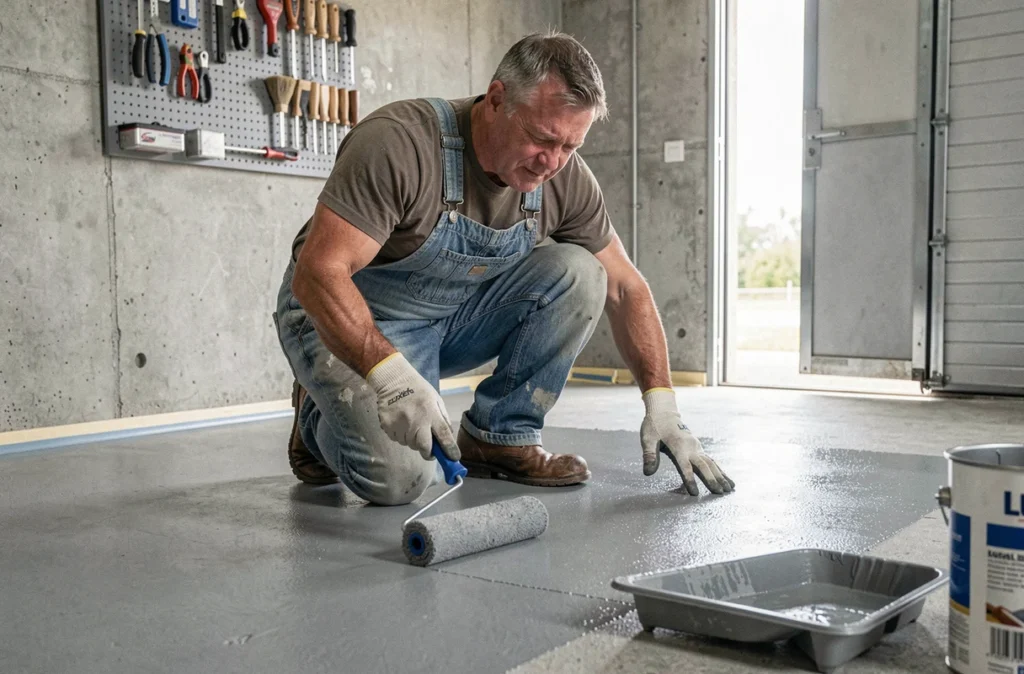
When repainting a garage floor, workshop, or basement corridor, the question quickly arises: does the Luxens floor paint, sold at Leroy Merlin, really live up to its promises on a surface walked on daily? The answer depends less on the paint itself than on the preparation of the surface and the number of coats applied. Here’s a field report on this product, its true strengths, and its concrete limitations.
Preparing the floor before application: the factor that Luxens does not address
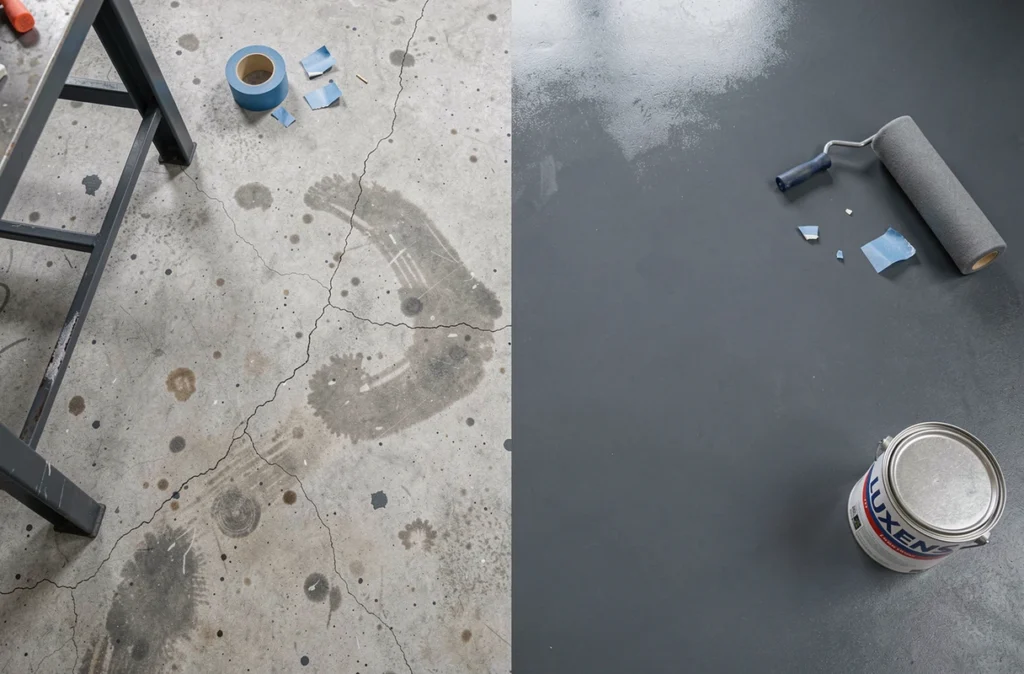
On a smooth surface (old tiles, polished concrete, resin slab), applying Luxens floor paint directly without a primer is like betting on adhesion. User feedback published on Leroy Merlin product sheets reports adhesion problems on poorly prepared surfaces. In practice, it appears that the promise of direct application only holds true on raw, porous, and clean concrete.
For other surfaces, a bonding primer remains the only serious guarantee. Users who have taken this shortcut report peeling within the first few weeks of regular use. Those who sanded, degreased, and then applied a primer achieve a long-lasting result.
You can also find reviews on Luxens floor paint that confirm this observation: the preparation of the surface weighs more heavily than the choice of paint in the final result.
Actual coverage of Luxens floor paint: how many coats to plan
The technical sheet indicates an application of one to two coats. In practice, this is rarely sufficient when the floor is dark, stained, or old. Several buyers report having applied two to three coats to achieve an even finish, especially on shiny surfaces or those with oil stains.
This point changes the budget calculation. A 2.5-liter pot covers a reasonable area in one pass, but if three coats are necessary, the consumption nearly doubles. It shifts from a very accessible product to a cost per square meter that is less advantageous than advertised.
Drying between coats: a deadline to be strictly observed
The water-based formulation allows for relatively quick touch drying. Complete drying, however, takes about twenty-four hours according to the Spanish product sheet available on Leroy Merlin. Applying the next coat too early can cause blisters or a film that never fully hardens.
In a garage or workshop used daily, immobilizing the floor for several days (the time needed to apply two or three coats with complete drying in between) represents a real logistical constraint. It is better to plan the work over an extended weekend.
Luxens floor value for money: what users remember
The price positioning of Luxens remains the main argument. It is a range distributed exclusively at Leroy Merlin, accessible and available in-store without special ordering. For a one-time project (refreshing a basement, painting a storage room), the value for money satisfies the majority of users who are willing to take care of the preparation.
Positive feedback focuses on three recurring points:
- Application with a roller is straightforward, even for non-professionals. The texture does not run, and the product is easy to work with.
- The satin finish provides a clean look and makes cleaning the floor easier once the film has hardened.
- The absence of strong odors during application (water-based formula) allows for indoor work without heavy mechanical ventilation.
The limitations are equally consistent:
- Resistance to heavy traffic (vehicle wheels, rolling chairs, daily foot traffic) remains the weak point. On a garage floor where a car drives every day, marks appear after a few months.
- The actual covering power often requires buying more product than expected, which diminishes the initial price advantage.
- On smooth floors, adhesion without a primer is not reliable, contrary to what the simplicity of the product might suggest.
Luxens floor paint versus alternatives: when to choose something else
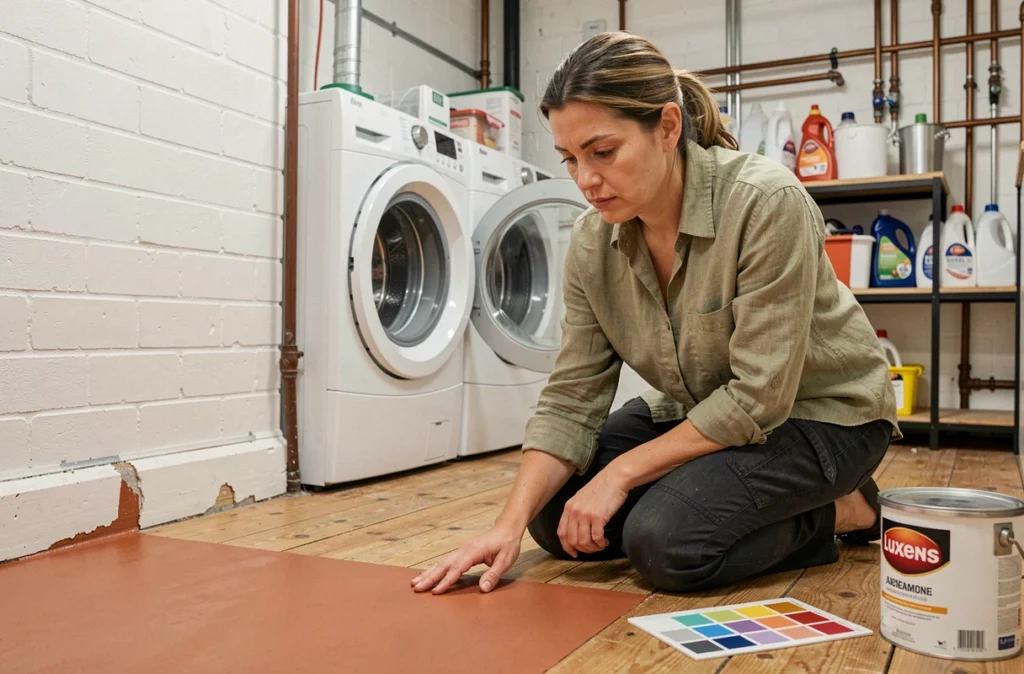
Luxens is suitable for moderate indoor use: laundry room, cellar, technical room, basement corridor walked on foot. For these surfaces, the product fulfills its role as long as the surface is properly prepared.
For a garage floor with vehicle traffic, an epoxy resin offers significantly superior mechanical and chemical resistance. The price per liter is higher, but the durability compensates over several years. The difference in performance between water-based acrylic paint and two-component epoxy resin is significant from the first months of intensive use.
Luxens outdoor floor paint: a common confusion
Questions about using Luxens floor paint outdoors (terrace, balcony, stairs) frequently arise. The satin interior reference presented by Leroy Merlin is designed for indoor use only. Exposing it to UV rays, rain, and temperature fluctuations accelerates the degradation of the film. For an outdoor floor, one must turn to paint specifically formulated to withstand the elements.
The Luxens range includes several references, and the characteristics vary from one product to another. Checking the technical sheet of the exact reference purchased avoids disappointments, as generalizing a review to the entire Luxens range is a common mistake.
In the end, Luxens floor paint does what it is asked to do within the limits of its formulation: an aesthetic refresh on a lightly used indoor floor, provided that preparation is not neglected. For a floor subjected to mechanical or chemical constraints, the product quickly reaches its limits, and a dedicated resin remains the most durable choice.