

A bathroom mirror that starts to show dark spots on the edges is often the first sign of a backing damaged by moisture. We postpone the intervention because we think that restoration requires professional equipment. In reality, several accessible techniques allow you to treat a spotted mirror at home, as long as you understand what is happening behind the reflective surface.
Window glass or mirror glass: a technical point that changes the restoration method
Before grabbing the cloth and white vinegar, you need to identify the type of glass. A mirror glass is specifically designed to receive a backing: its surface is polished on both sides, ensuring a clear and distortion-free reflection. A window glass, more common and less expensive, often shows slight visible ripples when viewed at an angle.
This distinction has a direct consequence. On an old mirror glass, the backing (tin or aluminum layer) adheres more uniformly. When it deteriorates, black spots appear in regular patches, often around the edges. On a window glass reused as a mirror, the deterioration can be more irregular and harder to address properly.
If you plan to easily restore a spotted mirror, this prior check prevents wasting time with an unsuitable method for the support.
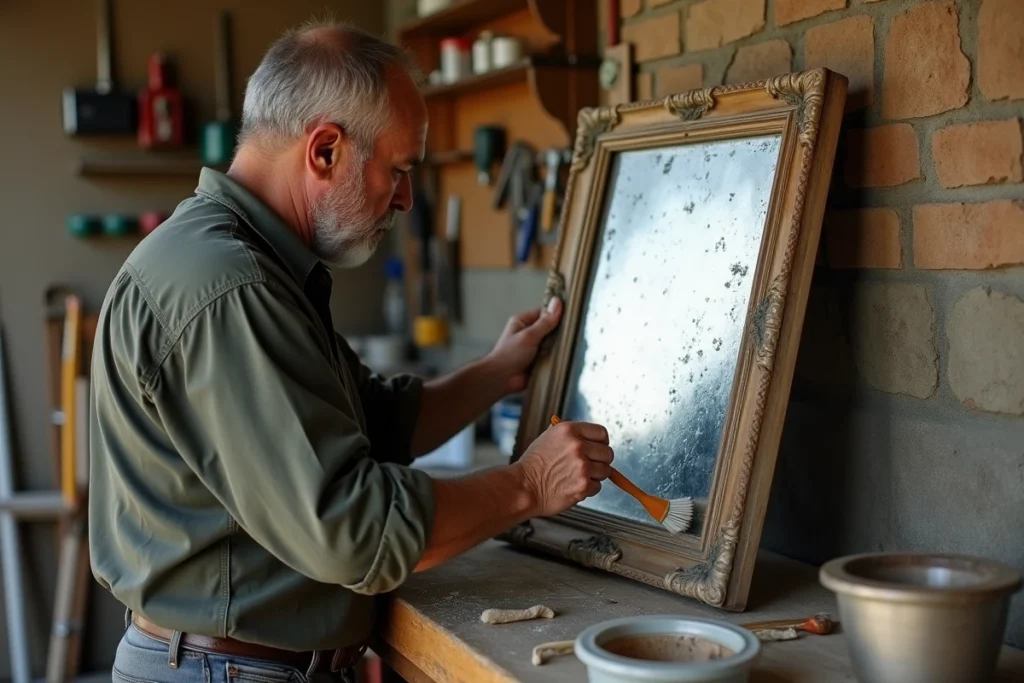
Cleaning the spotted mirror: the steps that prepare the surface
You do not restore a backing on a dirty surface. Cleaning is the first step, and it conditions the durability of any subsequent repair.
Clean the visible side without worsening the damage
Use a damp microfiber cloth with a mixture of warm water and white vinegar. Avoid ammonia-based products, as they can migrate to the edges and accelerate the degradation of the remaining backing.
The action is as important as the product. Wipe from the center to the edges, without insisting on areas where the backing is already gone. Rubbing these areas will not restore the reflection and risks detaching additional fragments.
Prepare the back of the mirror
If you plan to touch up the backing, you need to turn the mirror over and gently clean the back. Remove dust with a dry cloth, then identify areas where the protective layer (black or gray paint) is flaking. These are the precise spots where moisture seeps toward the backing.
- Remove flakes of paint with a flat razor blade, without scratching the glass
- Degrease the exposed area with a cotton pad soaked in household alcohol
- Let it dry completely before applying any product
Touching up the damaged backing: a realistic technique for a decent result
Touch-up kits for backing sold in drugstores generally contain an adhesive aluminum sheet or a silver solution to apply with a brush. The result will never be identical to an original backing, but it may suffice for limited areas at the edge of the mirror.
Apply the aluminum sheet shiny side against the glass, smoothing with a soft cloth to eliminate air bubbles. In field tests, results vary depending on the thickness of the sheet and the flatness of the glass. A sheet that is too thin crumples and creates unwanted reflections.
For central spots, artisanal touch-ups reach their limits. If the spotted areas cover a significant surface of the mirror, it is better to consider an approach other than backing restoration.
Embracing the spotted mirror: when the flaw becomes a decor choice
Online content emphasizes repair, but there is an alternative that antique dealers know well. A spotted mirror with a patinated frame is a sought-after item in contemporary decor. Oxidation spots create an effect of depth and authenticity that no chemical treatment can replicate.
Rather than attempting a risky restoration on a vintage mirror found at a flea market, you can choose to showcase it as is. Placed in an entryway or above a fireplace, a mirror with an irregular backing adds character without requiring any intervention.
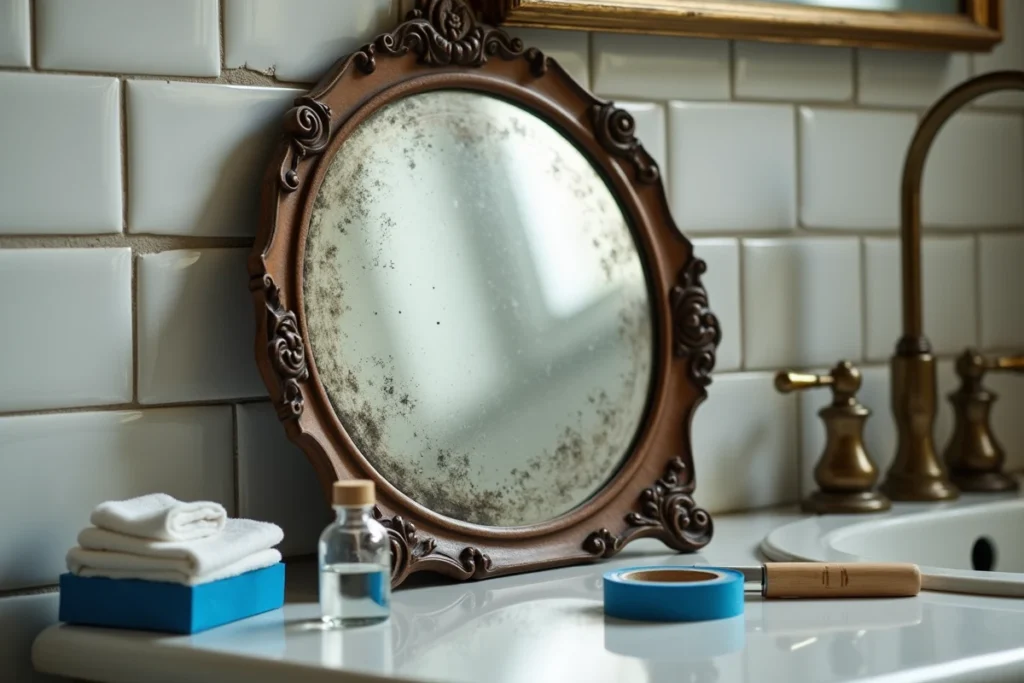
If the spots are still bothersome, you can visually diminish them by positioning the mirror in a less illuminated area or by pairing it with an imposing frame that diverts attention from the imperfections of the surface.
Preventive maintenance to protect a bathroom mirror
The majority of spotted mirrors become so due to prolonged exposure to moisture. A few simple habits can significantly slow down the process.
- Ventilate the bathroom after each shower, or activate the mechanical ventilation for at least fifteen minutes
- Apply a clear marine varnish to the back edges of the mirror, where water most often seeps in
- Avoid mounting the mirror directly against a damp wall, leaving a slight gap with spacers
- Regularly wipe condensation marks off the surface with a dry microfiber cloth
The marine varnish applied in two thin coats to the back of the mirror creates an effective barrier against moisture. It should be renewed every two to three years in a wet area.
A spotted mirror tells a story of moisture and time. Whether you choose to restore it, embrace it, or protect it to stop degradation, the right approach depends on the type of glass and the extent of the damage. On an old mirror with an ornate frame, the patina of the backing is often part of its charm. On a functional bathroom mirror, prevention remains the most cost-effective action.