
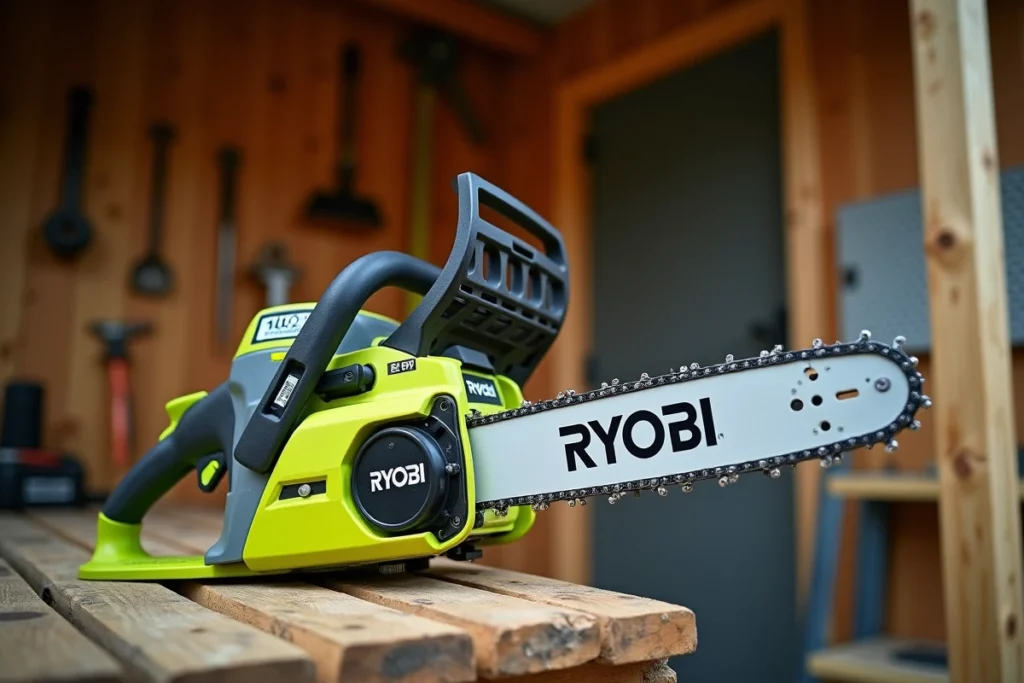
The Ryobi OCS1830 occupies a specific niche in the 18V chainsaw segment: that of a supplementary tool for pruning and cutting small wood, compatible with the ONE+ ecosystem. We have scrutinized it on the points that matter for a user already equipped with cordless tools.
Chain Speed and Actual Cutting Capacity of the Ryobi OCS1830
The data that separates this machine from its direct 18V competitors is its chain speed of 10 m/s. This figure places it among the fastest models in its voltage category, where many competing references peak around 7 to 8 m/s.
The 30 cm guide imposes a natural limit on the diameter of logs that can be tackled. On soft conifers (pine, spruce), we observe clean and consistent cuts up to about 25 cm in diameter. Beyond that, the brushed motor struggles, and the chain noticeably slows down, a sign that the power delivered by the 18V platform is reaching its physical ceiling.
The low-profile 3/8″ chain pitch (0.953 cm) corresponds to the entry-level standard. This technical choice limits the aggressiveness of the cut but reduces the risk of kickback, a coherent compromise for a tool intended for maintenance cuts rather than felling.
We compared our review of the Ryobi 18V OCS1830 chainsaw with available field feedback: Ryobi claims about 40 cuts in 15 cm logs with a 5.0 Ah battery, and 33 cuts with a 4.0 Ah. Independent tests confirm this order of magnitude, with up to 43 cuts recorded on a 5.0 Ah.
Brushed 18V Motor: What It Means for Durability
The OCS1830 features a brushed motor. This is a point that most product sheets mention without drawing the technical consequences. A brushed motor on a chainsaw means three concrete things.
- The brushes wear out proportionally to the operating time under heavy load. With regular use (one to two sessions per week in season), we estimate a replacement will be necessary after a few seasons of intensive use.
- The energy efficiency is lower than that of a brushless motor by 10 to 15%, which translates directly into reduced runtime at equal battery capacity.
- Heat dissipation is greater: during continuous work on hard wood, the machine heats up faster and the controller cuts off earlier to protect the electronics.
Ryobi offers brushless models in its ONE+ range (like the RCS18X3050F). The OCS1830 remains positioned as an entry-level option, and its brushed motor justifies its lower price in the range. For occasional use (less than 30 minutes per session), the difference in efficiency remains marginal.
Actual Runtime Depending on the Type of ONE+ Battery
The OCS1830 is sold without a battery or charger. This commercial choice is aimed at users already integrated into the Ryobi ONE+ ecosystem, which includes over 200 compatible tools on the same 18V platform.
The battery sizing radically changes the user experience. For light pruning (branches of 5 to 10 cm), a 4.0 Ah battery offers about 25 to 30 minutes of use. For more demanding cutting (15 cm logs), the runtime drops to about twenty minutes with the same cell.
We recommend working with a 5.0 Ah battery at a minimum for acceptable user comfort. The 2.0 Ah batteries, sufficient for a string trimmer or a drill, are undersized for a chainsaw that draws high current continuously.
A often overlooked point: the nominal voltage of 18V drops under load. With a partially discharged battery (below 40% capacity), the chain speed decreases noticeably and the quality of the cut deteriorates. Keeping a charged spare battery is not a luxury; it is an operational necessity.

Automatic Lubrication and Tool-Free Chain Tensioning
The automatic chain lubrication system works via an integrated oil pump. The reservoir, visible through a translucent window, allows for level checking without disassembly. In practice, the oil flow is calibrated for standard use and is not manually adjustable, which can be problematic on very dry wood where the chain heats up more.
The chain tension is adjusted via a side knob, without tools. This mechanism simplifies routine maintenance but requires frequent checking: during the first uses, the new chain stretches and requires retensioning every 10 to 15 cuts.
The chain brake is mechanical, activated by the front protection lever. Its activation is quick and its reset intuitive. This is a non-negotiable safety feature on this type of machine, and Ryobi has not skimped on this point.
Ergonomics and Weight in Real Conditions
With its compact dimensions (45 x 23 x 18 cm), the OCS1830 is easily handled with one hand for positioning, although cutting must always be done with two hands. The rubber-coated front handle absorbs some vibrations, and the lightweight design facilitates work at height during short sessions.
The center of gravity, with the battery mounted, remains close to the body of the machine. This is a real advantage for pruning in an outstretched arm position, where every gram off-center increases muscle fatigue.
The overall rating of 4.1/5 noted in independent test panels reflects a product that meets its specifications without claiming to exceed them. The OCS1830 will not replace a 40 cc gas chainsaw for cutting cords, but it manages the routine maintenance of a wooded garden with a reliability we have observed over several seasons of use in the ONE+ ecosystem.