

On a a Breton beach the day after a storm, you can sometimes find a dozen branches sculpted by water, wedged between seaweed and shells. The temptation to take them all is strong. The problem is that collecting driftwood at the wrong time or in the wrong place often means retrieving unusable pieces or even disturbing a discreet but active ecosystem: the strandline.
Strandline and driftwood: what we really disturb by collecting
The strandline, this cord of organic debris deposited by high tide, is not a pile of waste. It is a micro-habitat. Sea fleas, insect larvae, and small crustaceans feed and reproduce there, and these organisms in turn form the food base for shorebirds.
The driftwood found in this strandline plays a concrete role: it stabilizes the sand at the dune foot and provides shelter for invertebrates. Systematically removing all pieces of wood from a section of beach means removing part of this structure.
The field rule we apply is simple. We never take all the wood present along the same stretch of beach. We choose two or three well-formed pieces, leaving the rest in place, especially if the area is colonized by dune vegetation or if birds are nesting nearby.
To better understand when to collect driftwood according to Simply Habitat, it is beneficial to cross-reference the tide calendar with this ecological logic: the right time is not only when the wood is abundant, but also when the reasoned collection does not compromise anything.
Autumn high tides and storms: the real collection calendar
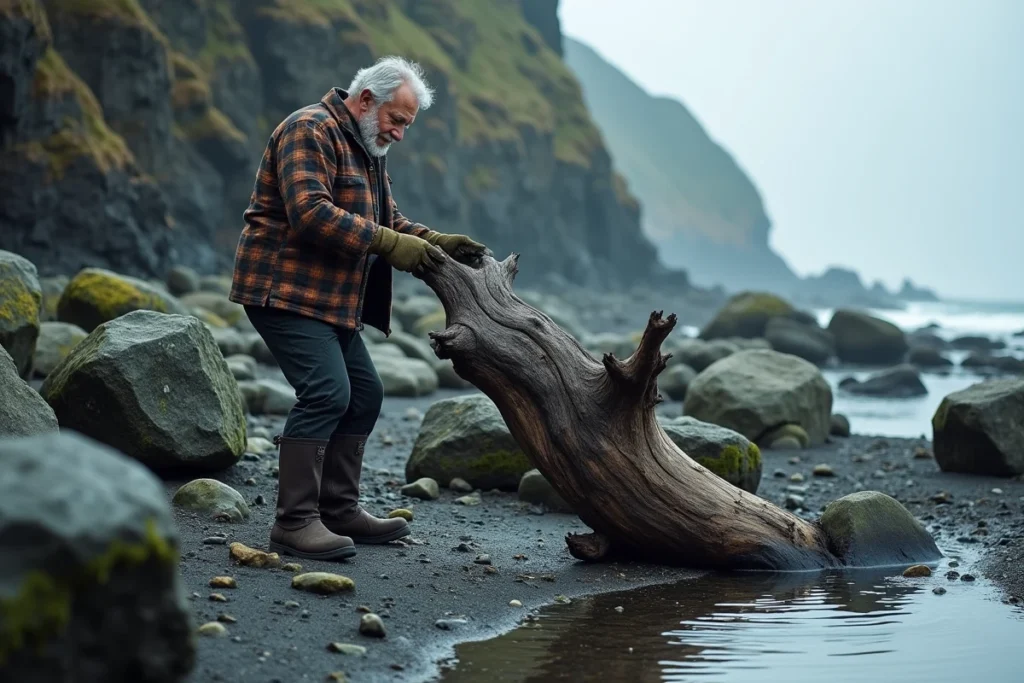
Field returns converge on one point: the best contributions occur after equinox tides and autumn-winter storms. The waves remobilize the woody debris carried by rivers and deposit it in large quantities on exposed beaches, both on the Atlantic coast and in the Mediterranean.
The most effective window is not the day of the storm itself (dangerous and impractical), but the falling tide just after the weather event. At this stage, the freshly deposited wood is still clearly visible, not heavily selected by other collectors, and in better condition for decorative use.
Waiting several days after the deposit has a clear disadvantage. The wood left wet on the sand begins to collect grains, to crack under the sun-moisture alternation, and sometimes to develop mold. The first hours after the water recedes remain the optimal time to spot healthy pieces.
Where to focus your search on the beach
We do not rake the entire beach. Natural accumulation areas are targeted:
- The top of the strandline, where the last high tide deposited its line of debris, often marked by a cord of dry seaweed.
- The dune feet and beach corners, where the current creates deposition zones sheltered from the prevailing wind.
- The areas sheltered by a rocky outcrop or a jetty, which trap the driftwood floating along the coast.
Focusing the search on these specific points saves time and significantly increases the proportion of usable pieces in the harvest.
Distinguishing a beautiful piece from wood to leave in place
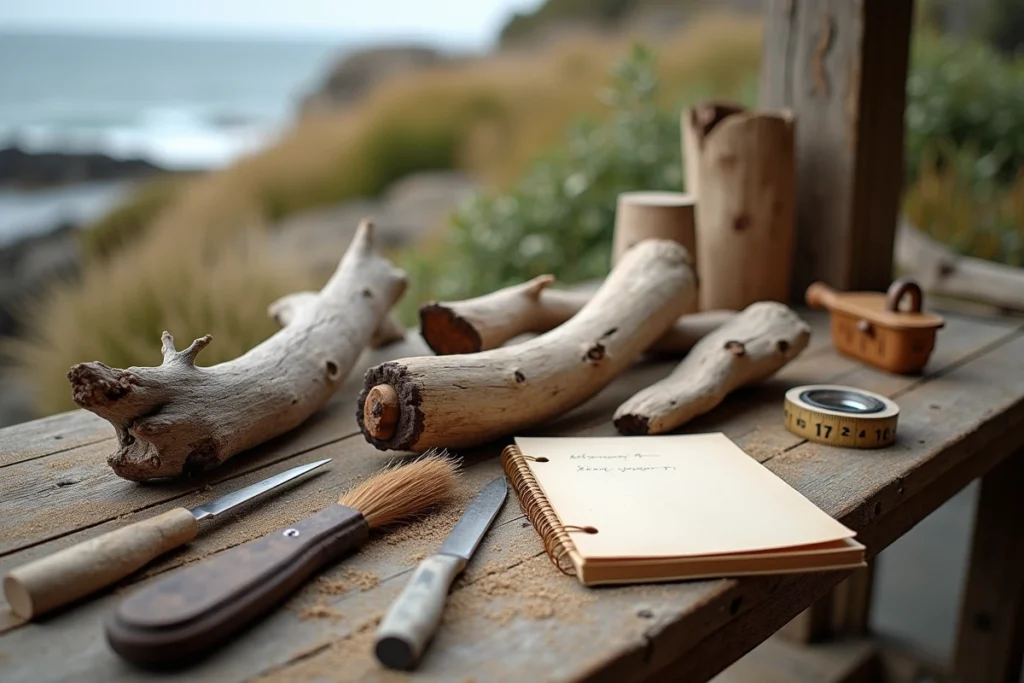
Collecting driftwood for decoration or creation is primarily about knowing how to sort on the ground. A good piece sounds solid when tapped and remains dense in hand. A bad piece crumbles, shows insect galleries, or emits a smell of stagnant moisture.
Here are the sorting criteria we apply directly on the beach:
- The surface is polished by salt and sand, without black spongy areas that indicate advanced decomposition.
- The wood does not break under moderate thumb pressure, a sign that it retains enough intact fibers for durable use.
- The absence of visible mold (green or black spots on the surface) and sour smell, which would indicate too long a stay in stagnant water.
- The shape has a specific interest for a concrete project: a natural curve for a lamp, a flat surface for a mirror or table, a branching for a coat rack.
Wood not to collect
Some pieces must remain on the beach. Wood still colonized by living organisms (barnacles, fixed algae, small shells) actively participates in the local food chain. Removing it means displacing an active biological support.
Very light and porous wood like a sponge has lost its internal structure and will not last over time, even after drying and treatment. We leave it to decompose on site, where it nourishes the dune soil.
Drying and initial treatment after collection on the beach
Bringing driftwood home without properly preparing it almost always leads to the same result: cracks, odors, and an invasion of wood-eating insects in the living room. Controlled drying is the first step before any creation project.
First, rinse the pieces in fresh water to remove embedded salt and sand. Bleach, often mentioned for whitening wood, is controversial: it attacks the surface fibers and destroys the natural patina that gives driftwood its aesthetic appeal.
Drying is then done in the open air, in the shade, for several weeks depending on the thickness of the piece. Returns vary on this point, but a low-temperature oven treatment can eliminate wood-eating insect larvae without risking cracking the wood. The residual moisture must be sufficiently low before considering any finishing or assembly.
Driftwood collected at the right time, carefully sorted, and properly dried can last for years indoors. A poorly chosen or rushed piece ends up in the trash within weeks. The whole difference lies in these field gestures, long before the first sanding stroke.