

Accommodation accounts for about one third of the budget for a round-the-world trip. This expense item, the most variable from one country to another, affects both daily comfort and the total duration of the journey. Choosing accommodations is not just about comparing prices on a platform: the type of accommodation, local regulations, and booking strategies profoundly alter the experience.
Short-term rental regulations: what changes for travelers
Competitors rarely address the impact of legal developments on the accommodation offer. The Le Meur law, gradually implemented in France between 2025 and 2026, caps the rental of primary residences at 120 nights per year. The most pressured municipalities (Paris, Marseille) can lower this threshold to 90 nights by simple municipal deliberation.
This restriction has concrete effects: in major French cities, the supply of tourist rentals like Airbnb is decreasing or becoming less stable. Accommodations available one season may disappear the next. Condominiums now have the option to prohibit short-term rentals by a two-thirds majority.
The phenomenon extends beyond France. The European Union is working to facilitate restrictions on short-term rentals in areas with high real estate pressure. European municipalities will be able to set quotas for seasonal rentals or cap the number of accommodations offered for nightly stays in a given neighborhood. For long-term travelers, this means that Airbnb availability now varies according to local regulations, not just demand.
Before relying on a private rental in a major European city, checking the current rules avoids unpleasant surprises upon arrival. This vigilance also applies when comparing accommodations on Tour du Monde to identify the most reliable options based on destinations.
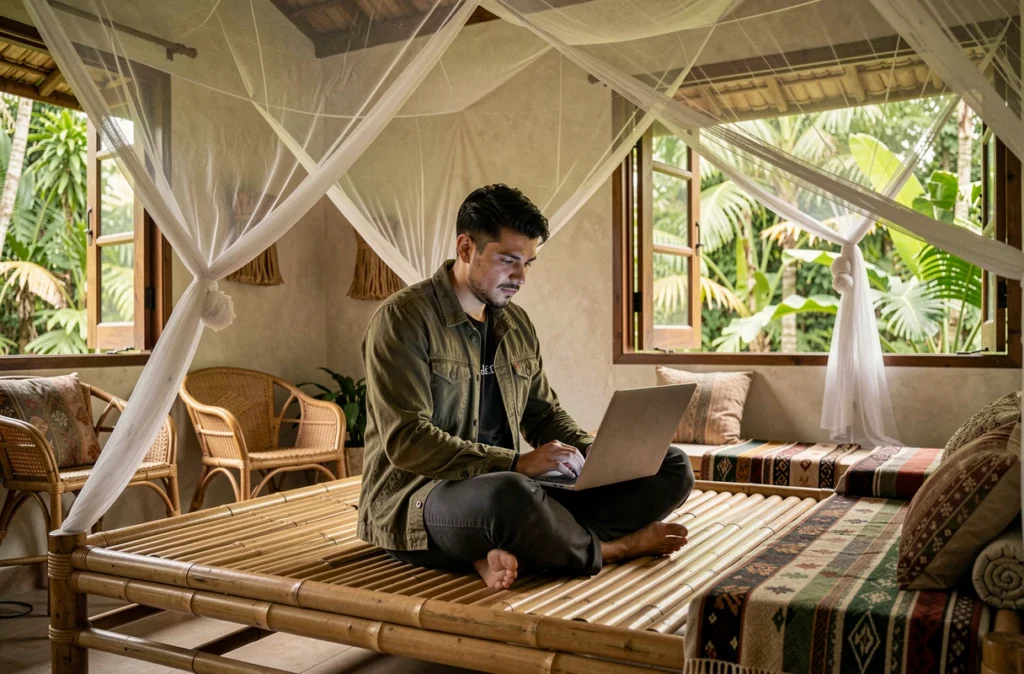
Criteria for choosing accommodation on a round-the-world trip
The reflex to seek the lowest price often leads to poorly calibrated compromises. The real starting criterion is the duration of the stay in each location. A one-night transit does not require the same type of accommodation as a ten-day stop to explore a region.
Duration of stay and type of accommodation
For a short stop (one to two nights), a dormitory in a youth hostel or a backpacker hotel is sufficient. Minimal comfort does not impact morale when leaving quickly. However, for a longer stop, a weekly rental apartment or a home exchange protects the budget and offers a space for recovery.
Adjusting the standard to the pace of travel allows one to sustain over time without blowing the overall budget. Alternating between budget options and more comfortable accommodations every ten to fifteen days acts as a safety valve.
Location and safety
Proximity to a transport hub (train station, bus terminal) reduces local travel costs and wasted time. In countries where the cost of living is low, a hotel close to the city center remains affordable. In large metropolitan areas, moving a few subway stations away significantly lowers the price.
Recent reviews (less than three months old) on booking platforms provide a more reliable picture than the overall rating. An establishment rated well but without recent reviews may have changed management or standards.
Free or nearly free accommodations: reliability and limits
Several options allow for lodging without paying for a night. Each involves trade-offs that need to be assessed before integrating them into an itinerary.
- House sitting: taking care of a house and its pets in exchange for accommodation. Registration on dedicated platforms costs a few dozen euros per year. The main constraint is the lack of flexibility, as dates and locations depend on the homeowners.
- Couchsurfing: free accommodation with a local host. The quality of the experience entirely depends on the host’s profile. Saturated major cities have fewer active hosts than a few years ago.
- Wwoofing and volunteering: agricultural or associative work in exchange for food and lodging. Suitable for travelers who have time and accept a rural living environment. Expect commitments of at least one to two weeks.
- Home exchange: swapping your own accommodation with that of another traveler. Functional only if one retains a home during the round-the-world trip.
These options never cover the entirety of an itinerary. Planning them as a complement (one stop out of three or four) remains the most realistic strategy.

Advance booking or on-site: deciding based on the destination
Booking in advance provides reassurance but can sometimes be more expensive. In Southeast Asia, backpacker hotels often offer lower counter rates than those displayed online, as they save on the commission paid to platforms. Negotiating on-site, especially in low season, remains common.
Conversely, in European destinations or high-traffic areas (Japan during cherry blossom season, Patagonia in the Southern Hemisphere summer), booking two to four weeks before arrival secures the price and availability. The supply diminishes even faster as regulations on short-term rentals limit the available stock.
A hybrid approach works well: book the first night in each new country to avoid arrival stress, then search on-site for subsequent nights. This method combines logistical security with budget flexibility.
The choice of accommodation on a round-the-world trip relies less on the type of lodging than on the ability to adjust one’s strategy country by country. Travelers who set a single rule for the entire itinerary end up paying too much in certain regions or finding themselves in unsuitable accommodations in others. Flexibility in accommodation mode is as strategic as choosing destinations.