
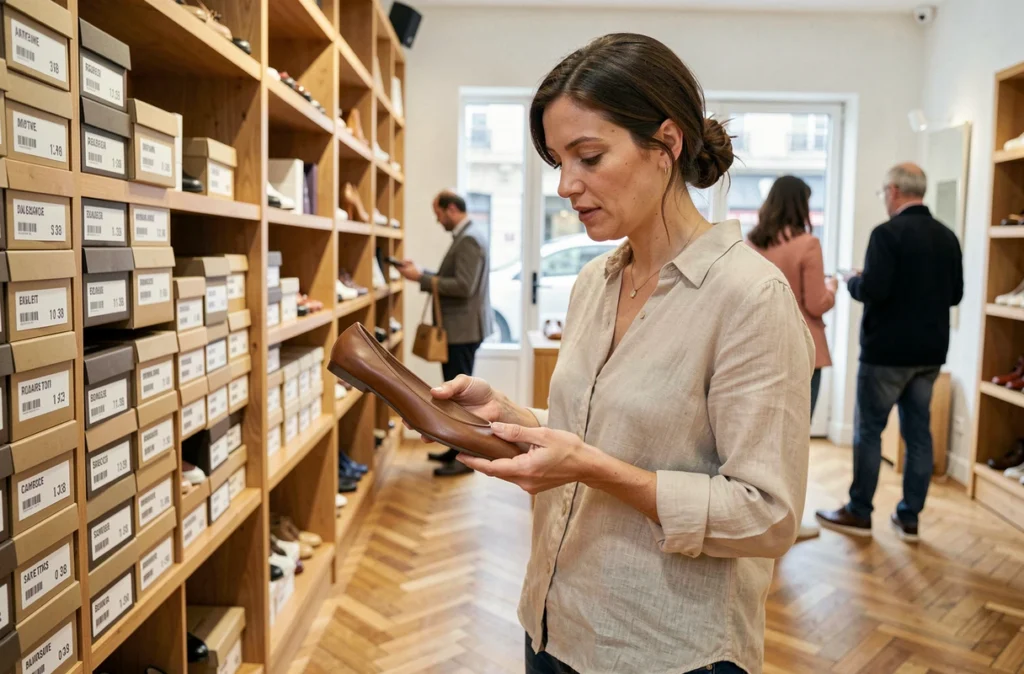
In France, men’s size 42 and women’s size 38 consistently top sales rankings. These two benchmarks shape the offerings of retailers, guide production volumes, and determine stock depth in stores. Behind this seemingly simple answer, the reality of the French shoe market reveals several gray areas that traditional rankings do not document.
Size and unit of measurement: why the displayed number poses a problem
The European shoe sizing system is based on the Paris point, a unit that corresponds to two-thirds of a centimeter. Therefore, a size 42 theoretically indicates an interior length of about 28 cm.
In practice, the displayed size varies significantly from one brand to another. A size 42 from Nike does not cover exactly the same foot length as a size 42 from an Italian manufacturer or a French hiking brand. The discrepancies arise from shape choices (the width of the shoe, the height of the shaft, the volume of the insole), but also from different industrial tolerances depending on the factories.
This lack of uniformity undermines any national ranking based solely on labels. When it is claimed that the most common shoe size is 42 for men, it aggregates sizes that do not measure exactly the same thing. The number remains a useful indicator for retailers, but it does not describe a uniform anatomical reality.
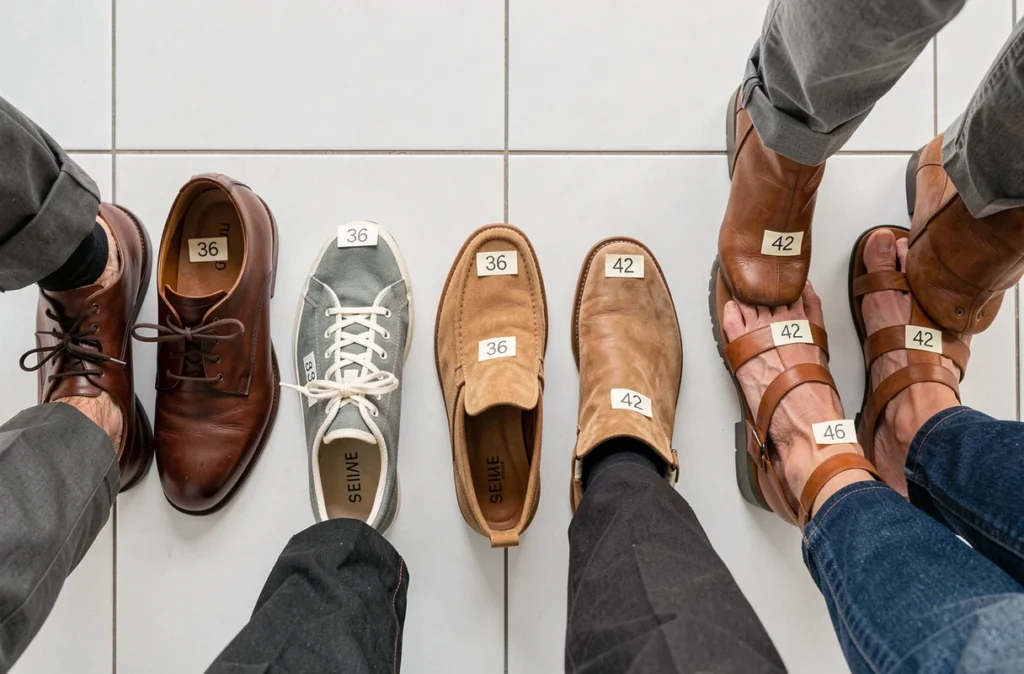
Size 42 and size 38: what sales really say
The ranking of the best-selling sizes in France places men’s size 42 and women’s size 38 at the top. These two sizes concentrate the highest order volumes at most generalist retailers.
This data deserves to be nuanced on several levels:
- The type of shoe influences the size purchased. Flat shoes, whose sales increased by 18% in France in 2025 according to Madame Figaro, do not require the same fit as a pair of heels or ski boots. A consumer may wear size 38 in sneakers and size 39 in ankle boots.
- Seasonality shifts demand. Winter models (thick lining, heavier sock) often lead to taking a half size up. Summer sales peaks (sandals, open shoes) bring consumers back to their usual size.
- The sales channel alters returns. Online, return rates for incorrect sizes remain high, skewing the net sales statistics by size.
Sizes 42 and 38 remain reliable benchmarks for sizing stock, but they mask a real dispersion around these averages.
Evolution of French feet: a shift towards larger sizes
Several observations converge on the fact that Europeans’ feet have grown over the past few decades. RTBF already reported that sizes had gained a few sizes in about twenty years. This phenomenon also affects France.
The often-cited causes are nutritional and morphological: a richer diet, an increasing average body size, and lifestyles that differently engage the arch of the foot. The available data does not allow for precise quantification of the shift in France, but feedback from retailers confirms a growing demand for sizes 43 and 44 for men, and 39 and 40 for women.
For retailers, this trend complicates stock management. A section calibrated for men’s size 42 risks running out in sizes 43 or 44, while smaller sizes (39 for men, 36 for women) remain on shelves longer. The adjustment is slow because orders to manufacturers are made several months in advance, based on historical averages that poorly incorporate recent changes.
French shoe market in 2025: volume and regulatory constraints
The French market recorded 281 million pairs of shoes sold in 2025, which is 11 million more than in 2024, according to Madame Figaro. This growth shows a dynamic sector, but it is not evenly distributed across all sizes or segments.
The rise of flat shoes absorbs a significant share of this growth. Sneakers, ballet flats, and loafers drive the volumes, at the expense of heeled shoes whose market share is declining. This shift alters the distribution of sizes sold, as the comfort of flat shoes encourages less adjustment of size relative to usual size.
European regulation and accuracy of sizes online
Since December 13, 2024, the European regulation on the general safety of products (EU) 2023/988 requires online sellers to display more comprehensive product information, including the identity of the manufacturer and product identification. This requirement does not directly address the issue of size heterogeneity, but it pushes marketplaces to better structure their product listings.
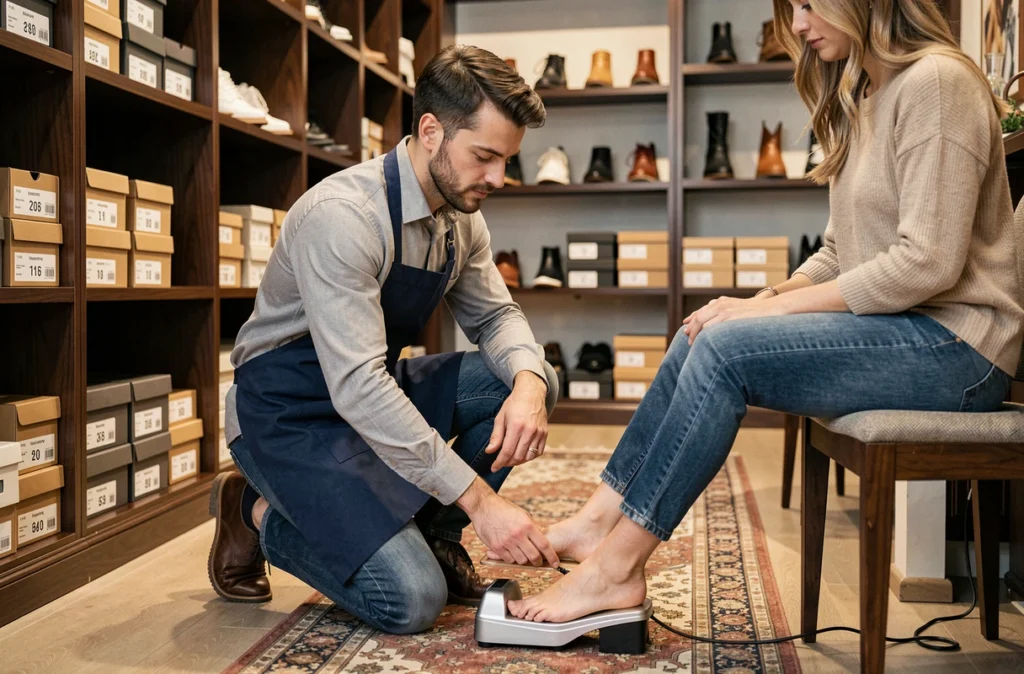
Platforms that provide length in centimeters in addition to size facilitate consumer choice and reduce returns. Some French retailers are beginning to integrate foot measurement tools (scan via smartphone), an approach that could, in the long run, make size classification less central in the purchasing decision.
The best-selling size in France remains size 42 for men and size 38 for women, but this ranking reflects more of a stock convention than a precise anatomical measurement. The gradual shift towards larger sizes, the diversification of shoe types, and new online information obligations outline a market where the displayed size could lose relevance in favor of the actual foot measurement.