

The fennec, a small canid from the North African desert, attracts attention with its miniature silhouette and disproportionate ears. In France, its ownership falls under a strict legal framework that classifies this animal among non-domestic wild species. Before any action, the regulatory framework requires specific authorizations, and ongoing legislative changes could profoundly alter the conditions of ownership for individuals.
Positive list of species: a deadline that changes the game for the fennec
Law n°2021-1539 of November 30, 2021, introduced the principle of a positive list of non-domestic species authorized for ownership by individuals into the Environmental Code. Any species not on this list will be strictly prohibited as a pet.
This list, initially announced for the end of 2023 and then postponed to early 2024, has yet to be published. The Prime Minister has made it a priority project to be finalized by the end of 2026. For anyone considering adopting a fennec in France, this deadline is crucial: if the species Vulpes zerda is not included in the ministerial order, ownership will become illegal, with no guaranteed transition period.
Field reports vary on this point: some breeders anticipate the inclusion of the fennec among tolerated species, while others believe that European regulatory trends are moving towards increasing restrictions on wild canids in captivity. The available data does not allow for a conclusion in either direction until the order is published.
Certificate of capacity and prefectural authorization: current obligations
While waiting for the positive list, the current regime is based on two pillars. The first is the certificate of capacity for the maintenance of non-domestic animals, issued by the prefecture after reviewing the applicant’s file (experience, training, knowledge). The second is the prefectural authorization for the opening of an establishment holding captive wild fauna, including in a private home.
Without these two documents, owning a fennec constitutes an offense. The Environmental Code provides for severe penalties:
- One year of imprisonment and a fine of 15,000 euros for keeping a non-domestic animal without authorization
- Confiscation of the animal, which will be placed in a care center or an approved establishment
- Possible prohibition on owning any animal for a duration set by the court
The fennec is also listed in Annex II of CITES (Convention on International Trade in Endangered Species). Any acquisition therefore requires verifying the traceability of the animal and the legality of its importation, with valid CITES documents.
Conditions for keeping a fennec: what animal welfare truly demands
The fennec is a nocturnal animal, native to the Sahara, adapted to extreme temperature variations and vast sandy spaces. Transposing these conditions into a French home presents very concrete constraints.
Space and setup
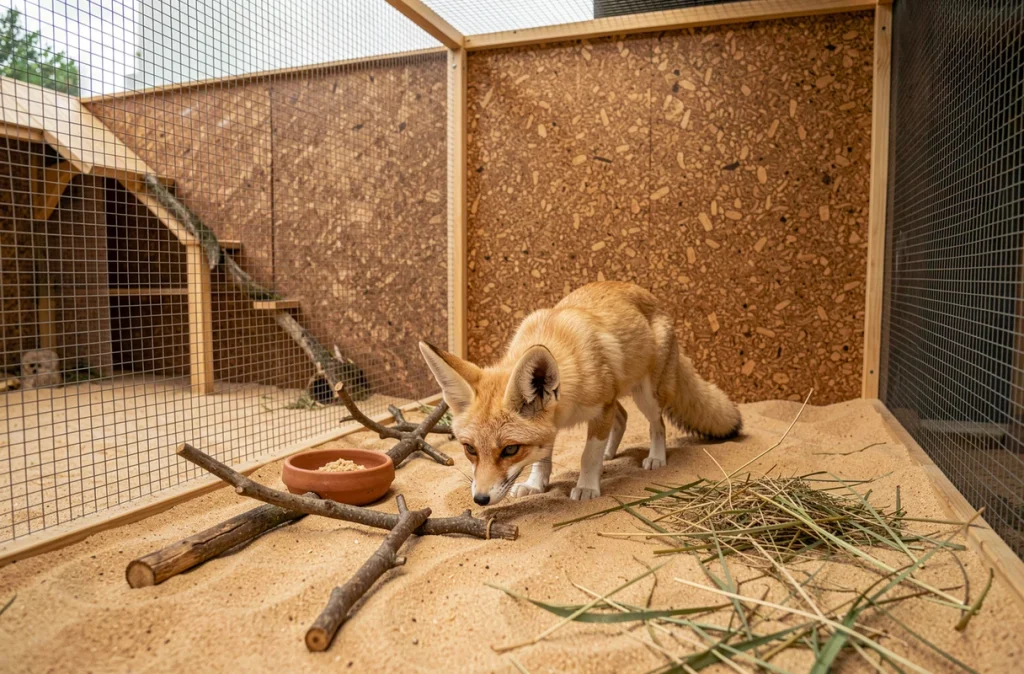
An outdoor enclosure is necessary, and not just a fenced park. The fennec actively digs: any fence must be buried deeply to prevent escapes. The space should include sandy areas, thermal shelters, and protection against humidity, to which the animal is particularly sensitive.
Diet and veterinary care
The fennec’s diet is omnivorous, primarily insectivorous and carnivorous. In captivity, it requires an intake of animal proteins (insects, small prey), supplemented by fruits and vegetables. Finding a competent veterinarian for exotic NAC remains a major obstacle in most French regions. Fennec pathologies are poorly documented in common veterinary medicine, complicating diagnosis and treatment.
The fennec does not behave like a dog or a cat. A fearful animal, it rarely tolerates handling. Its nocturnal vocalizations can be intense. The smell of its urine markings is strong and persistent. These behavioral realities explain a high abandonment rate among poorly informed owners.

New penalties on the sale of animals in pet shops: a regulatory signal
A decree published on August 1, 2026, and commented on by Service-Public.fr, introduced new penalties for pet shops. The fine reaches the 5th class (up to 1,500 euros per animal, 3,000 euros for repeat offenses) for the transfer of dogs or cats, and the 4th class (up to 750 euros per animal) for the display of animals visible from public roads, regardless of the species.
This decree does not directly target the fennec. However, it reflects a general tightening of French regulations on the ownership and commercialization of animals. The legislative trend is clearly moving towards stricter regulation, and potential fennec buyers must consider this context in their reflection.
Buying a fennec: the concrete risks of the current market
The fennec market in France operates without a centralized platform or systematic control. Advertisements circulate on private groups, social networks, and a few declared breeders. This opacity generates several risks:
- Animals imported without CITES documents, exposing the buyer to criminal prosecution
- Fennecs from inbred lines with undisclosed health problems
- Sellers who do not verify that the buyer holds a certificate of capacity
- Absence of post-sale follow-up and no standardized health guarantee
The prices charged vary significantly depending on the origin and legal status of the animal. A significant gap between two offers should raise concerns about the legality of the transaction.
Adopting a fennec in France remains technically possible under the current regime, but the window may close with the publication of the expected positive list by the end of 2026. Anyone who engages in this process without a valid certificate of capacity and without prefectural authorization is exposed to criminal penalties. The legal framework leaves no room for interpretation on this point.