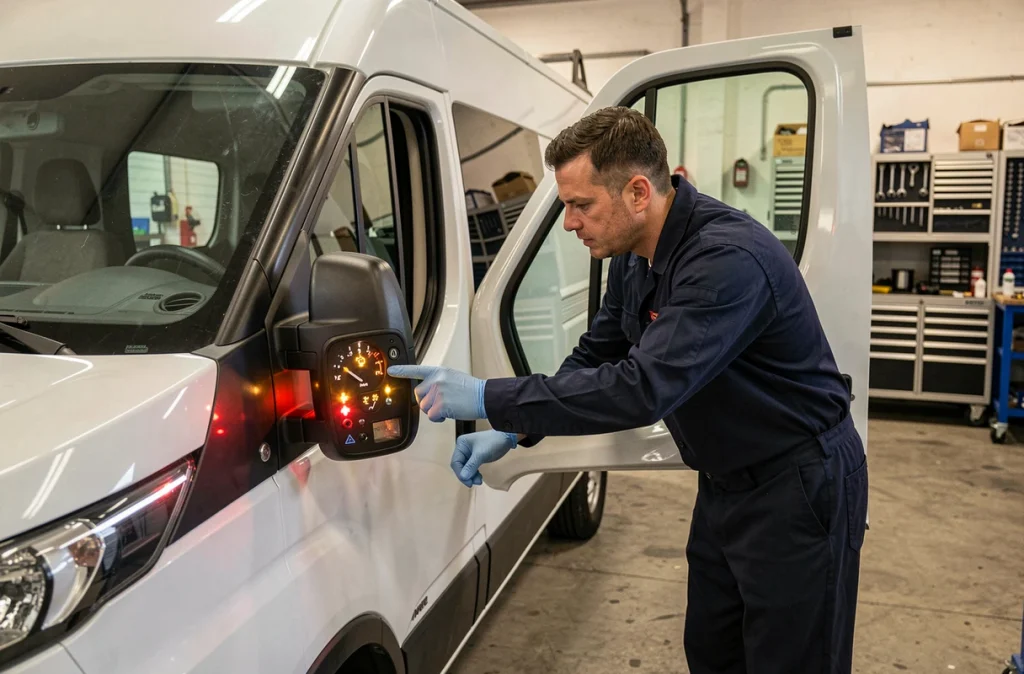
An orange warning light comes on the dashboard of your Iveco Daily during a delivery run. Should you stop, continue to the depot, or call the garage directly? The answer entirely depends on the specific light, its color, and its behavior (steady or flashing). This guide reviews the warning lights that cause the most problems on this utility vehicle, along with the concrete reactions to adopt for each situation.
AdBlue Warning Light on Iveco Daily: The Lockout Sequence to Know
On Euro 6 diesel Iveco Daily vehicles, the AdBlue warning light does not just indicate a low level. It triggers a lockout escalation sequence that can lead to a restart blockage. Most drivers discover this operation too late, once immobilized in a parking lot.
The logic is progressive. First, a yellow light appears with a message indicating the remaining mileage before restriction. If no action is taken, the warnings become more urgent. Next, the vehicle enters limp mode with a noticeable loss of power. At the final stage, the engine simply refuses to restart after stopping.
This escalation is not a choice by Iveco: it responds to the requirements of Euro 6 anti-pollution regulations, which require the ECU to prevent prolonged use without AdBlue. For a utility vehicle used in professional activity, the consequences are direct: vehicle immobilization, delays, loss of revenue.
A simple top-up of AdBlue is not always enough to turn off the warning light. There are regular cases where the light remains on despite a full tank. The problem then lies with the quality sensor, the dosing pump, or the SCR ECU.
In these situations, an electronic diagnosis is necessary to reset the system. To better understand the meaning of the dashboard lights on Iveco Daily, it is essential to distinguish between alerts that can be resolved with a top-up and those that require a workshop visit.
Red Warning Lights on Iveco Daily: Immediate Stop or Not
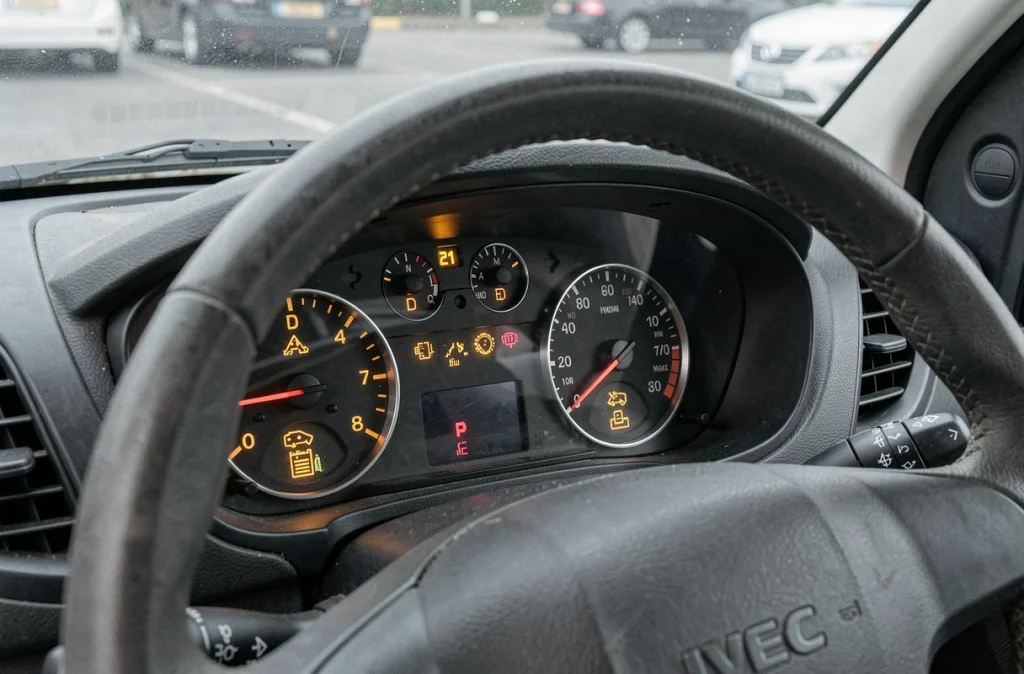
Red warning lights leave no room for interpretation. They indicate a serious problem that threatens the mechanics or safety. On a Daily, three red lights frequently appear in the workshop.
Engine Oil Pressure
This light in the shape of a canister lights up when the oil pressure drops below the critical threshold. Turning off the engine within seconds is the only appropriate reaction. Continuing to drive, even for a few hundred meters, risks causing engine seizure. First, check the oil level when cold. If the level is correct and the light persists upon restarting, the vehicle should not move without a mechanic’s intervention.
Coolant Temperature
The overheating light (thermometer in water) requires stopping quickly and allowing the engine to cool down. On a Daily loaded in summer or during prolonged climbs, this light may sometimes appear due to a stuck thermostat, a clogged radiator, or a faulty fan. Never open the expansion tank cap when hot: the pressurized fluid can cause severe burns.
Battery Warning Light
The battery light (rectangle shape with + and -) lights up when the alternator is no longer charging properly. The vehicle can still run on the battery reserve, but the range is measured in minutes. Reaching a nearby garage is still possible if the distance is short, but electrical equipment (air conditioning, radio) should be turned off to conserve remaining energy.
Orange Warning Lights on Iveco Daily: Alerts That Can Be Managed While Driving
Orange and yellow lights signal anomalies that do not require an immediate stop but need attention in the coming days. Here are the most common on the Daily:
- Engine light (check engine): it may indicate an injection, sensor, or anti-pollution issue. The vehicle usually runs normally, but an OBD diagnosis is recommended quickly to identify the specific fault code.
- Particulate filter light (DPF): it indicates excessive clogging. A prolonged trip on the highway at high RPM often allows for automatic regeneration. If the light remains on after several attempts, a forced regeneration in the workshop will be necessary.
- Power steering light: driving is still possible but harder, especially at low speeds. The system may have an electrical or hydraulic fault depending on the generation of the Daily.
- Airbag light: it does not affect driving but means that the restraint system will not deploy in the event of a collision. It should be checked as soon as possible.
On a flashing orange light, the situation is more urgent than on a steady light. A flashing check engine light, for example, often indicates misfires that can damage the catalyst. It is better to reduce speed and head to a garage.
OBD Diagnosis on Iveco Daily: Reading the Codes Behind the Lights
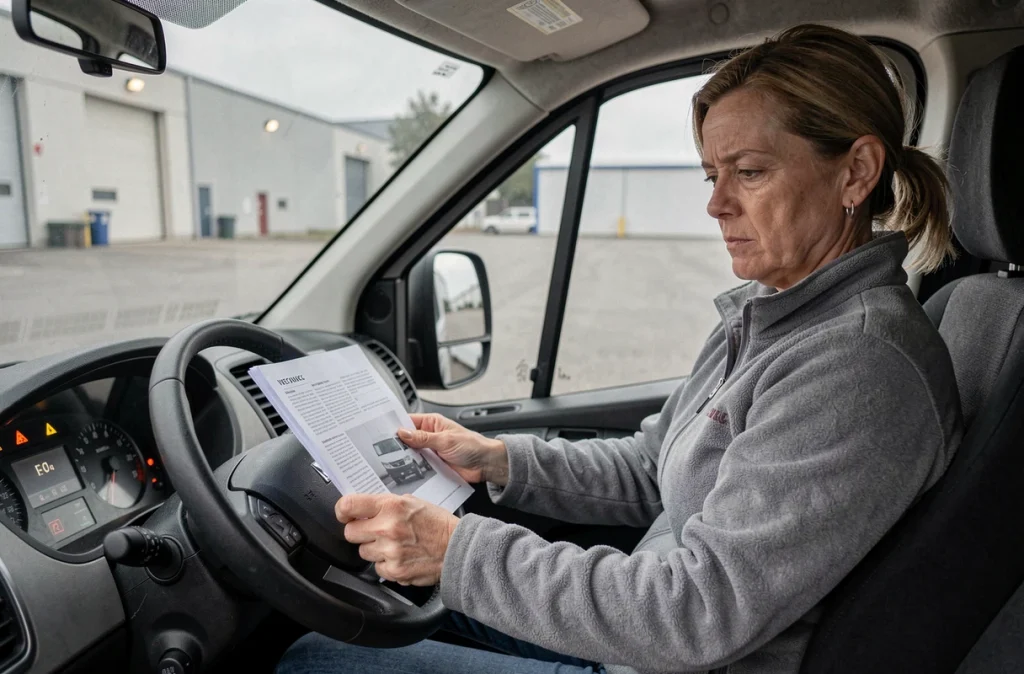
A warning light gives direction, not a diagnosis. To precisely identify the fault, an OBD reader is connected to the diagnostic socket of the Daily, usually located under the steering wheel on the left. The tool retrieves one or more fault codes (standard format P0XXX for the engine, C0XXX for the chassis) that guide the search.
General OBD2 readers available on the market read standard engine codes. To access specific Iveco codes (AdBlue system, automated gearbox, body electronics), a tool compatible with the Iveco protocol is often necessary. Feedback varies on this point: some multi-brand readers cover part of the manufacturer codes, while others are limited to the bare minimum.
Clearing a fault code without resolving the issue is pointless. The light will return in the next driving cycle if the fault persists. The fault code is an indication, not a definitive answer: it points to a circuit or sensor, but the root cause (oxidized wiring, unsoldered connector, worn part) often requires physical inspection.
Keeping an OBD reader in the glove compartment of the Daily allows for time savings when facing an unexpected warning light during intervention. Identifying a fault code before calling the garage helps prepare the part and reduces the vehicle’s downtime.