
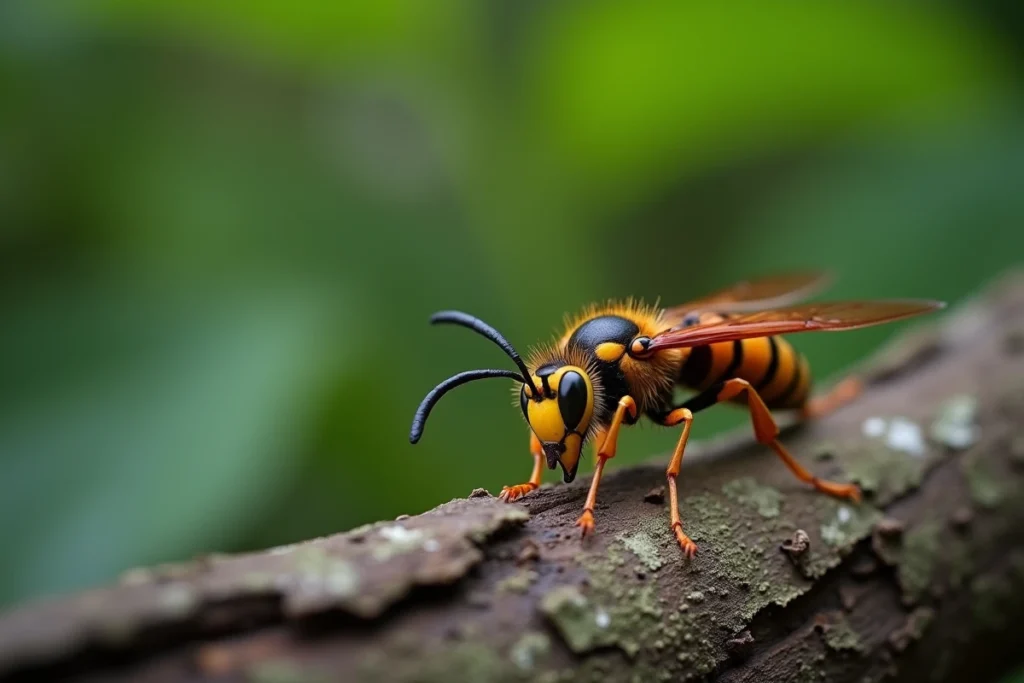
When talking about the giant hornet, the reflex is to think of pain, swelling, medical emergency. The venom of Vespa mandarinia indeed causes local reactions that can be severe and, in rare cases, fatal anaphylactic shocks. However, recent research is looking at this same venom from a radically different angle: its molecular components could serve as therapeutic tools.
Mastoparan and membrane permeability: what the venom does to cells
In the clinical field, a sting from the Japanese giant hornet triggers a rapid inflammatory cascade. The intense pain, ranked among the strongest in hymenoptera, is explained by a cocktail of peptides that directly attack cell membranes.
Among these peptides, mastoparan plays a central role. This molecule activates mast cells, immune cells that massively release histamine. The immediate result: edema, redness, pulsating pain. At high doses or in allergic individuals, the reaction can become systemic.
What interests Japanese and Korean researchers is precisely this ability to disrupt membrane permeability. Mastoparan does not just destroy: it opens calibrated breaches in cell walls. Biotechnological research is exploring this property for the effects of giant hornet venom in a drug delivery context, meaning the ability to introduce an active ingredient into a target cell.
Giant hornet venom and cancer research: concrete avenues
The idea of repurposing a deadly venom to target tumor cells is not new. This is already done with certain snake or scorpion venoms. The venom of Vespa mandarinia has a specific advantage: its peptides can partially distinguish healthy membranes from altered membranes.
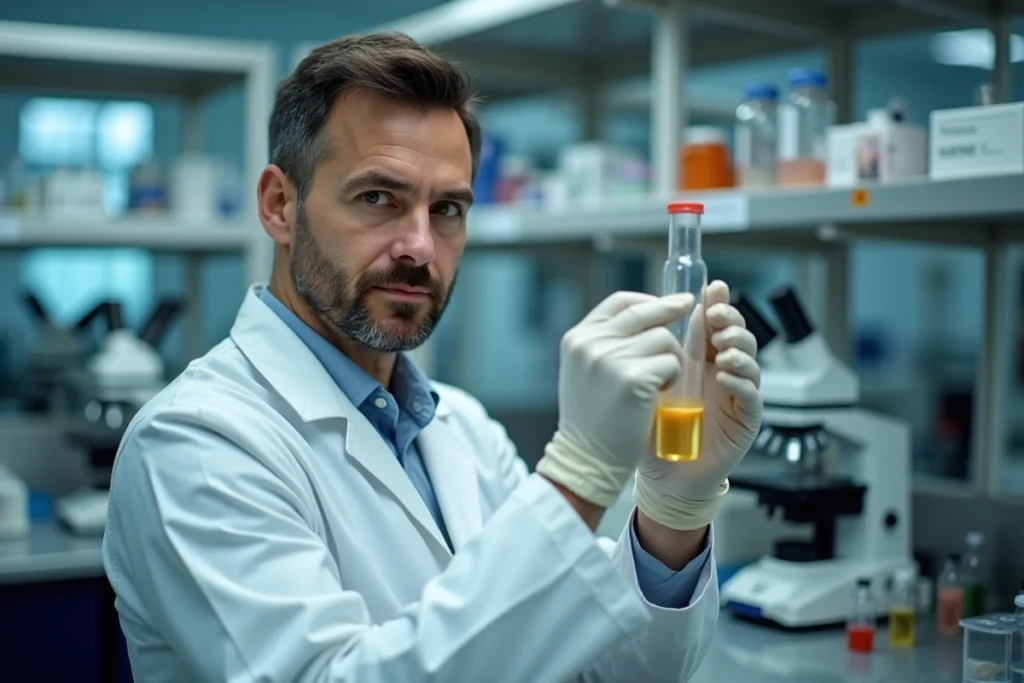
Cancer cells often have a lipid composition different from that of normal cells. Mastoparan and related toxins from giant hornet venom interact more with these modified membranes. In the laboratory, this relative selectivity allows for the consideration of a targeted drug delivery system where the peptide transports or facilitates the entry of a drug into the pathological cell.
We are still far from a medication available in pharmacies. Feedback varies on the residual toxicity of these peptides once chemically modified. Several teams are working to reduce the inflammatory effect while maintaining membrane penetration capability, a delicate balance that explains the slow progress toward clinical trials.
Toxicity of hornet venom: why pain is a misunderstood signal
Intensity of pain is often associated with the severity of danger. With the giant hornet, this correlation is misleading. Extreme pain does not predict life risk, which depends more on the allergic background of the person and the number of stings received.
The venom acts on several simultaneous fronts:
- Phospholipases destroy the membranes of red blood cells, causing hemolysis that can affect the kidneys in cases of multiple stings.
- Neurotoxins interfere with nerve transmission, amplifying the pain sensation well beyond the actual tissue injury.
- Vasoactive peptides cause a drop in blood pressure, distinct from classic anaphylactic shock but equally dangerous.
In Japan, several dozen deaths each year are attributed to stings from giant hornets. The majority occur in individuals who are stung repeatedly or have an undiagnosed allergic history. The hornet’s sting, which can reach 6 mm, allows for successive stings without the insect losing it, unlike the domestic bee.
A molecular cocktail more complex than that of wasps
The composition of the venom of Vespa mandarinia differs significantly from that of common wasps or even the European hornet. The concentration of mastoparan is significantly higher, which explains the intensity of local reactions. The volume of venom injected per sting is also greater than that of most other hymenoptera.
This molecular richness is precisely what attracts biochemists. A simple venom, with one or two active components, offers fewer research avenues. The giant hornet’s venom contains a repertoire of molecules with varied mechanisms of action, each potentially exploitable in a different therapeutic context.

Immune modulation by venom: beyond cancer
Research is not limited to oncology. The peptides from giant hornet venom capable of activating mast cells are also of interest in immunology. Understanding how mastoparan triggers a massive immune response could help design more effective vaccine adjuvants, capable of stimulating innate immunity without causing uncontrolled allergic reactions.
Research is also exploring pain modulation. The neurotoxins in the venom, by blocking or overactivating certain ion channels, provide a model for developing new analgesics. The goal would be to identify the peptide fragments responsible for nerve blocking without retaining the destructive effect on tissues.
This research remains at the fundamental stage. No product derived from giant hornet venom is currently in clinical trial in humans. The distance between a promising molecular property in the laboratory and a viable treatment is measured in years of development, even decades.
Giant hornet in France: a health threat distinct from the Asian hornet
Vespa mandarinia is not yet established in France, unlike the Asian hornet (Vespa velutina) which is present in a large part of the territory. The two species are often confused in the press, but their risk profiles differ.
- The giant hornet (Vespa mandarinia) measures up to 5 cm for queens, has a 6 mm sting, and a venom more concentrated in cytotoxic peptides.
- The Asian hornet (Vespa velutina) is smaller, with venom whose toxicity per individual sting remains comparable to that of the European hornet.
- The main risk of the Asian hornet in France is ecological (destruction of bee colonies) rather than directly health-related for humans, except in allergic individuals.
Monitoring Vespa mandarinia in Europe is a matter of preventive vigilance. If the species were to establish itself, its more potent venom would pose an additional health problem compared to the current situation with Vespa velutina, while paradoxically opening easier access to molecules of interest for European biomedical research.
The venom of the giant hornet remains primarily a real danger for anyone near a nest. The therapeutic avenues it opens do not change this ground reality. They simply remind us that biochemistry does not classify molecules as “good” or “bad”: it seeks to understand their mechanisms, and then to repurpose them.